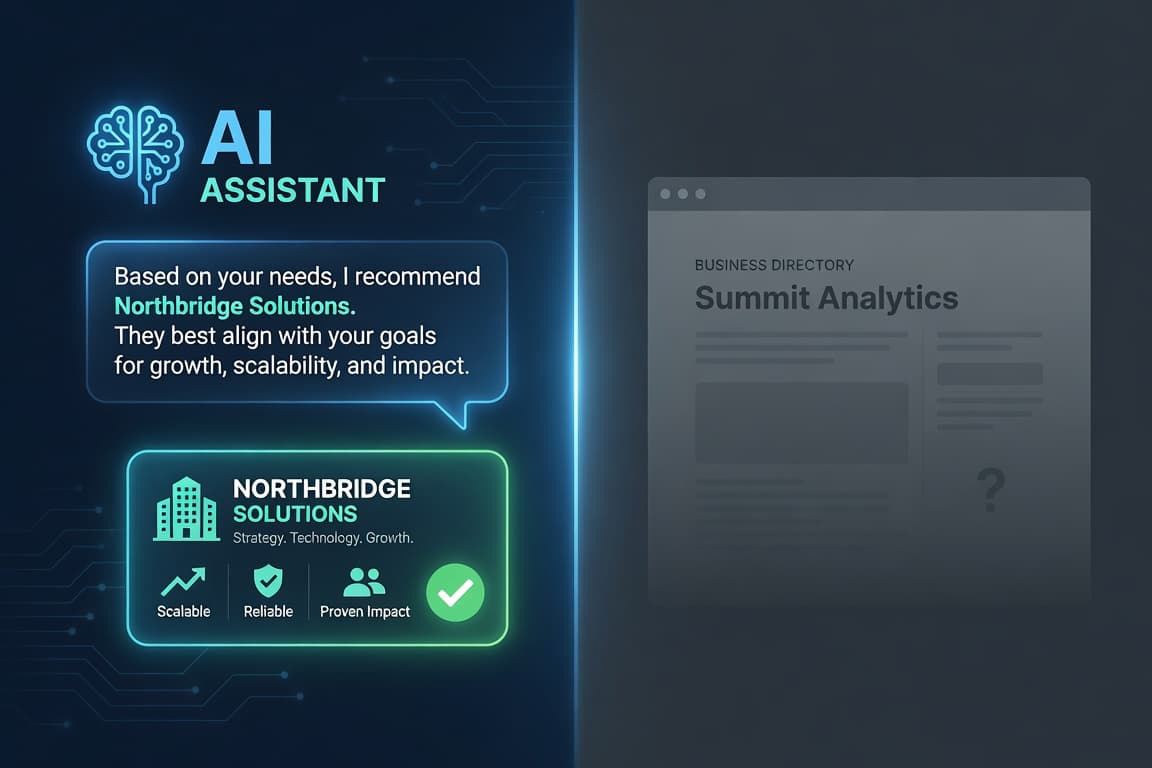
Your next customer probably won’t open ten browser tabs and compare websites. They’ll ask ChatGPT, Perplexity, or read Google’s AI Overview, get three names, and contact the first one. If your business isn’t in that answer, you never enter the shortlist. And most websites, old and brand new alike, are partly or completely unreadable to the systems now writing those answers.
The good news: this is a technical problem with a finite list of causes, and every one of them is checkable and fixable. Below is what these systems actually read, five checks you can run yourself in ten minutes, and why the fix is a repair job rather than a marketing campaign.
Why doesn’t my website show up in ChatGPT or AI answers?
Short answer: AI assistants can only recommend sites they can fetch, parse and trust. Most sites fail on at least one of five points: AI crawlers are blocked in robots.txt or by the CDN, the page is rendered only by JavaScript so the bot sees an empty shell, there is no structured data telling machines what the business is, the content never states plainly what you do and for whom, and there is no llms.txt or clear entity information. Fix those five and your site becomes citable; the checks below take ten minutes.
What AI assistants and search engines actually read
When ChatGPT or Perplexity decides whether to mention your business, it does not look at your design. It reads the machine layer underneath. Five things matter most.
Structured data. Machine-readable markup (JSON-LD) that states who you are, what you sell, and what it costs. Most sites have none, or implemented in a way crawlers never see. A common mistake on modern stacks is injecting it through a script loader so it never reaches the raw HTML.
Crawler access. Many sites accidentally block AI crawlers or were never configured to admit them. You cannot be cited if you cannot be read. Search bots like Googlebot and Bingbot must always be allowed; AI crawlers such as GPTBot, PerplexityBot, and OAI-SearchBot should be allowed if citation visibility matters to you.
Clean signals. One canonical address per page, correct language tags, and a coherent heading order. When these conflict, machines pick a version of your site you did not intend, or skip the page.
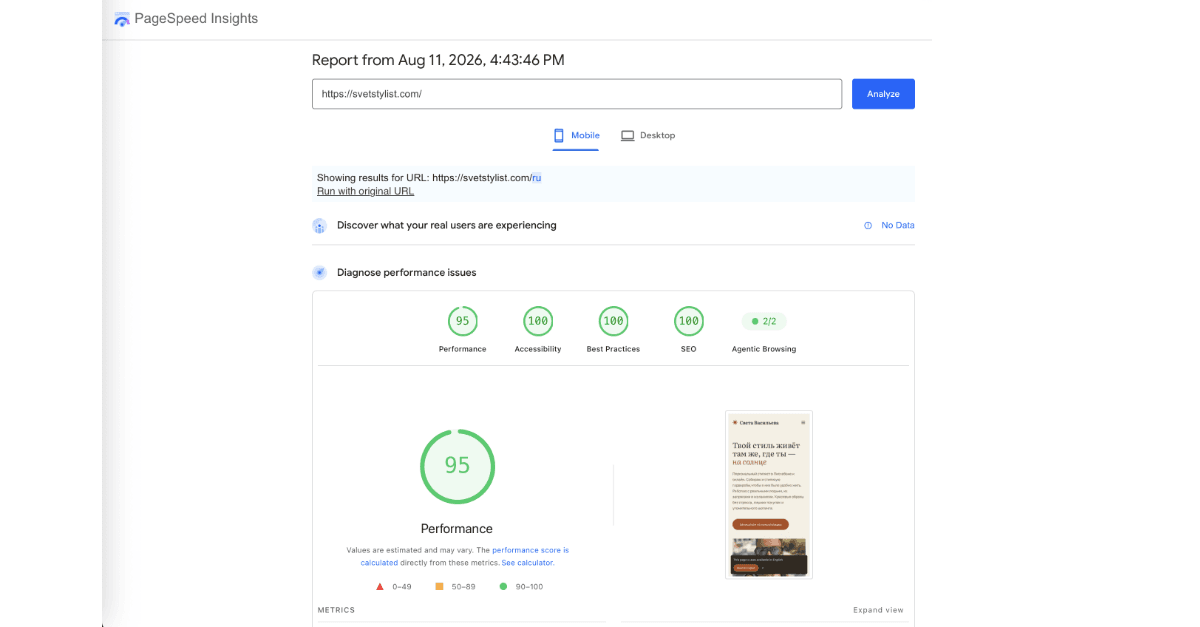
Speed. Slow pages get crawled less and rank lower. A single unoptimized hero image is often the entire problem. Targets worth meeting: Largest Contentful Paint under 2.5 seconds, and a PageSpeed score above 70 on mobile.
llms.txt. A new convention that tells AI systems what your site is about in plain text. Almost nobody has it yet, which is exactly why adding it stands out.
None of this is visible when you look at your own homepage. It looks fine. It is fine, for humans.
“But we just rebuilt our site”
This is the most common objection and the most expensive assumption. New websites fail these criteria as reliably as old ones, because developers are paid to ship design and features, not search infrastructure. Sites launched weeks ago routinely go live with missing canonical tags, blocked crawlers, and structured data no machine can parse.
A rebuild can make things worse. Your domain history, indexed pages, and backlinks are equity that Google already trusts. Rebuilding without a careful 1:1 redirect migration resets that trust and usually ships with the same technical gaps anyway.
Five checks you can run today, free
You do not need anyone for a first read on where your site stands.
- Ask ChatGPT (with web search on) and Perplexity about your product category in your city. Are you named? Are your competitors?
- Search
site:yourdomain.comon Google. Is the page count roughly what you would expect? - Run your homepage through Google’s PageSpeed Insights. Under 70 on mobile means you are losing crawl priority.
- Open
yourdomain.com/robots.txt. If the contents are unclear to you, they were probably unclear to whoever wrote them, and may be blocking the wrong things. - Paste your homepage into Google’s Rich Results Test. No detected items means machines see a blank business card.
Fail two or more, and your site is underperforming everywhere that matters, in classic Google results and in AI answers alike.
Why this is a repair, not a retainer
When most business owners hear “SEO,” they picture a monthly fee, vague reports, and results in six months, maybe. The technical layer does not behave like that. It is a finite checklist. Either a page declares a canonical URL or it does not. Either your structured data validates or it does not. Either AI crawlers can read you or they cannot. Every item is checkable, fixable, and provable once.
That is also why an audit alone rarely helps. An audit hands you a PDF describing problems and leaves the fixing to you, which usually means to nobody, because your developer is busy and your marketing manager cannot deploy code. The report ages in a drawer while the site stays broken.
The honest version of a guarantee: nobody can promise you rankings, and you should walk away from anyone who does. What can be promised is that your site measurably meets the technical criteria search engines and AI services check, documented item by item, before and after.
How a fixed-scope fix works
The service behind this article is a one-time, done-for-you repair built on a 31-section playbook proven on production sites. Three steps, fixed price, 7 to 14 days, no retainer and no ticket handed back to your team.
- Scan. Your site is run against the full checklist (1 to 2 days).
- Fix. Every applicable correction is implemented directly in your code and configuration (5 to 10 days).
- Prove. You receive a before and after report: Lighthouse scores, validated structured data, and Search Console status.
It covers indexing and canonical hygiene, JSON-LD structured data, multilingual hreflang signals, Core Web Vitals, heading and content structure, and AI readiness (llms.txt, crawler access, extended snippet directives). Platforms: WordPress and modern JavaScript stacks such as Next.js.
Frequently asked questions
Will this guarantee I rank first on Google?
No, and treat anyone who promises that with suspicion. The guarantee is that your site will measurably meet the technical criteria search engines and AI assistants check, documented before and after.
My site is new. Do I still need this?
Most likely yes. New sites fail the same technical checks as old ones because they were built for design and features, not search infrastructure.
How is this different from an SEO audit?
An audit tells you what is wrong. This finds the same issues and fixes them in your code, for one price, so nothing is left for your team to implement.
How long does it take?
Typically 7 to 14 days end to end: a 1 to 2 day scan, 5 to 10 days of fixes, then a verification report.
Why does ChatGPT recommend my competitors and not me?
Usually because their site is readable to AI crawlers and yours is not, or their structured data validates and yours is missing. These are fixable causes, not a verdict on your business.
See where your site stands
If you want a concrete first read, request a free 10-point mini-scan: send your URL and you’ll get the first issues worth fixing, with no obligation.
Get your free mini-scan at nesmachny.com/seofix.
Sergey Nesmachny builds and repairs web infrastructure for European businesses on WordPress and modern JavaScript stacks (Next.js and similar).